Located about 20km to the southeast from the center of Osaka, Tondabayashi
is rich in nature. There are open fields in the basin of the Ishikawa River which flows through the center of the city. A mountainous district
in the south links to the Kongo mountains. And green hills spreads in the
west. Tondabayashi is a city colored with old history and culture, and
is still growing.(*1)
This historical district and community dates back to the Age of Provincial
Wars (Sengoku Jidai, 15th-16th centuries) when a branch temple of the Koshoji temple took the initiative
in newly developing the area in cooperation with four neighboring villages. Jinaimachi literally means religious towns developped by and around a Buddhist
temple (Jodo-shinshu Sect.) during the Age of Provincial Wars where self-governed
and self-defensed systems had worked under the strong political influence
of the Buddhist Sect.. Some of those Jinaimachi(s) have still left their
old town planning and name as a historical district, Tondabayashi Jinaimachi
is one of those Jinaimachi towns.
The historical district, located at the top of terrace of the Ishikawa
River, is approximately 350 meters from east to west and 350 meters from
north to south. The area was divided into square blocks in an orderly line
under the town planning. In many parts of the community, there are remnants
of devices to avoid being involved in the battles between feudal warlords,
including rock barriers, bamboo groves, outer moats, entrance gates and
crossings which do not intersect at right angles, which were characterized
as a self-governed religious town used to be during the Age of Provincial
Wars. (*2)
Jinaimachi district prospered as the center of trade and distribution in
the southern part of Kawachi region. It is characterized by Jonomonsuji
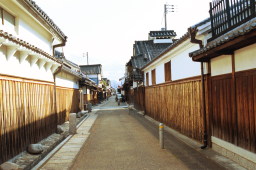
Street (selected in the 100 roads in Japan) which has a row of stores and
houses spanning the Edo, Meiji and Taisho eras. There are horse-hitching
stones at the entrance, stone guideposts for reminding visitors of fire
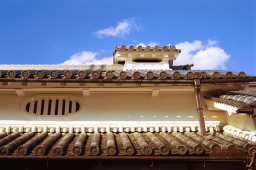
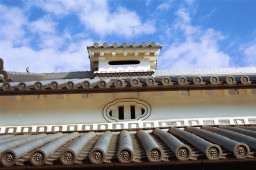
prevention, and white mortar and cedar-panelled walls of old merchants'
residences line the streets.
Fortunately, free from the urbanization or industrialization after the
world war II, there still remain a very rare traditional landscape and
local community. There are about 500 buildings in the town, about 200 of
which are of traditional style, including the former residence of Sugiyama
family and the residence of Nakamura family which prospered as brewers
of “sake” in the Edo period. The former residence of Sugiyama family
where "tanka" (*3) poet Ms. Tsuyuko Isonokami (the Meiji era)
was born was designated as an important cultural property of the Nation.
Thanks to a lot of efforts by the local municipality and residents for
preservation of the histrorical district, Tondabayashi Jinaimachi was designated
as an important histoirical district and heritage site of Japan in the
year of 1997. To preserve the original landscape of the historical district,
the exterior appearances of old merchants' residences had been made up
to the original design, colors and structures. Now no single utility pole
can be seen along the stone-paved Jonomonsuji Street as the landscape used
to be in old times. There people still live an ordinary life in the calm
atmosphere of the town.
You can visit here in about 30 minutes from the center of Osaka (Abenobashi or Tennoji terminal) and you can enjoy a journey back
to the old days.Visitors information is available at Tondabayashi Station on Kintetsu Railways
Nagano Line. In the town, there are guideposts available to visitors. The
main street, Jonomonsuji Street, is also lighted up in the evening.
We are most welcome to your visiting Todabayashi Jinaimachi. Let's see
you here.
Remarks
(*1): quotation from Todabayashi city guide 1996
(*2): quotation from Tourist Guide “Meet Osaka” 2001 published by Osaka Tourism Federation.
(*3): "Tanka" is a Japanese original verse form.
|